
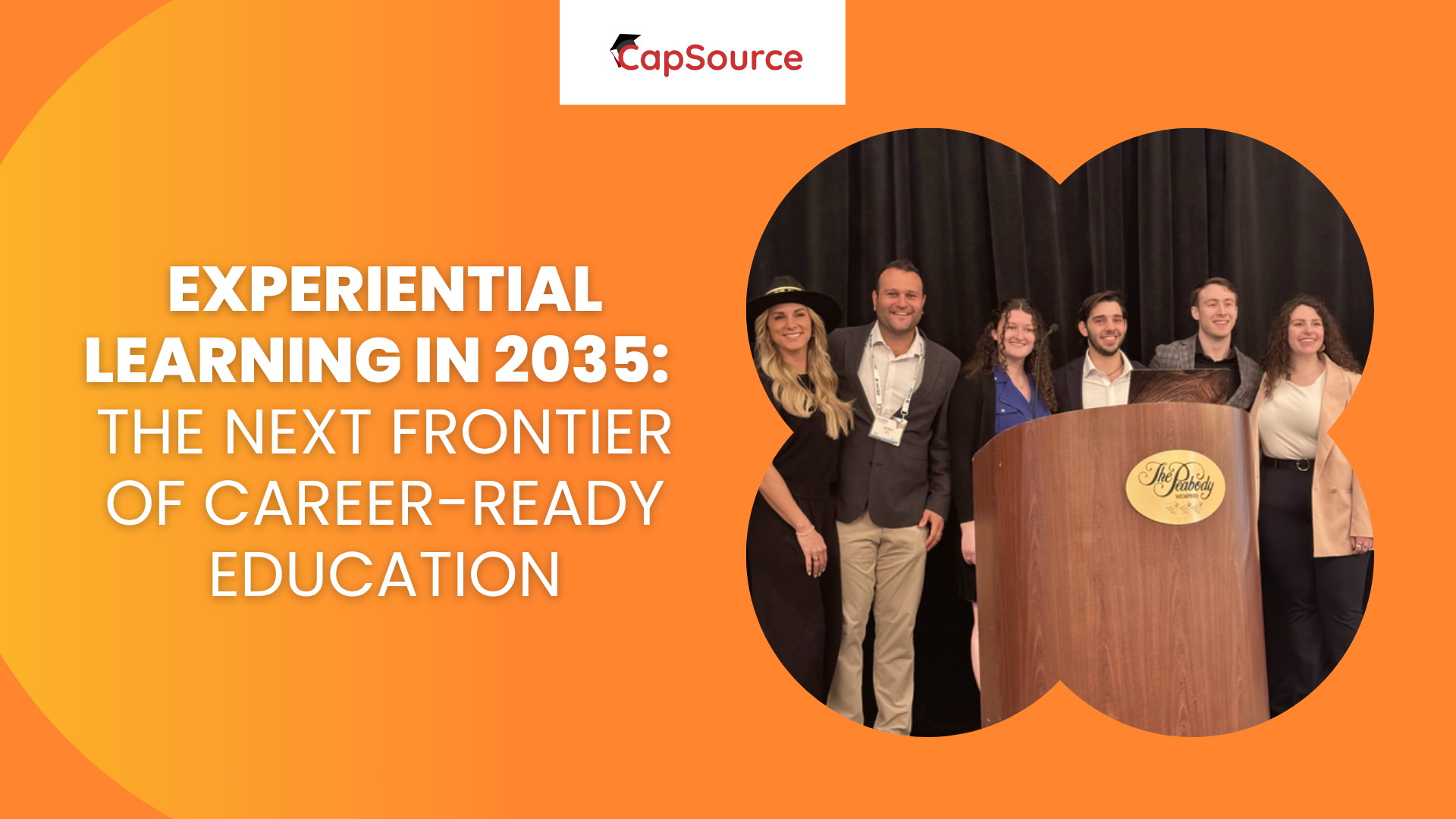
Experiential Learning in 2035: The Next Frontier of Career-Ready Education

In 2017, higher education was only beginning to grasp the potential of experiential learning. Faculty widely agreed that hands-on, real-world engagement led to deeper learning, but traditional lectures still dominated.
Fast-forward to 2025, and the landscape looks remarkably different. A new NACE–AAC&U–SEE report on career readiness and experiential learning reveals that 90% of educators now integrate career outcomes or skill-based experiences into their teaching.
That’s an extraordinary leap in less than a decade. What was once a niche pedagogy has become a cornerstone of modern education. But if the past eight years were about adoption, the next ten must be about innovation.
From Adoption to Intention
While more institutions now include experiential elements, many still struggle with depth and intentionality. Fewer than half of faculty consistently integrate structured reflection, mentorship, and applied assessment into these experiences.
By 2035, experiential learning must evolve into something more holistic, a living, adaptive ecosystem where students, educators, and employers co-create learning through technology and human collaboration.
This means going beyond one-off projects or internships. The next generation of experiential education should:
- Seamlessly integrate AI and data tools to personalize feedback, track progress, and model real-world problem solving.
- Empower students as creators, using technology to simulate entrepreneurial, civic, and interdisciplinary challenges.
- Embed reflection and ethics into every experience, helping learners evaluate impact—not just output.
AI as the Experiential Accelerator
Artificial intelligence won’t replace experiential learning… it will amplify it!
Imagine AI-assisted project design tools that help educators quickly align real-world business problems with learning outcomes. Or intelligent reflection platforms that analyze student journals and provide feedback on teamwork, critical thinking, and communication skills.
By 2035, these systems will act as co-instructors, ensuring that every experience (whether a business consulting project or a public policy simulation) meets clear learning and career-readiness standards.
Educators who embrace AI as a collaborator, not a competitor, will unlock new capacity to design, scale, and measure experiential learning at unprecedented levels.
How Educators Can Evolve
Here’s how colleges and universities can start preparing today for the experiential future:
- Shift from content delivery to challenge design.
Instead of asking, “What should I teach?” ask, “What problem should students solve?” - Use technology to guide, not replace, reflection.
Reflection is the secret sauce of experiential learning—AI can prompt and personalize it, but human mentorship must anchor it. - Connect learning directly to employability.
Frameworks like the NACE Career Readiness Competencies are powerful tools to help educators measure outcomes beyond grades. - Collaborate with industry, not just observe it.
The future of higher ed lies in partnerships that make classrooms look more like incubators, design studios, and policy labs. - Build systems, not silos.
By 2035, every student experience (academic, co-curricular, and work-based!!) should connect through an institution-wide experiential framework.
How CapSource Helps Educators Get There
CapSource already powers the kind of experiential learning ecosystem 2035 demands.
Through CapSource Projects, faculty can instantly connect with real organizations that bring authentic challenges into the classroom. Students gain access to real-world problems; faculty get structured support; and institutions can track learning outcomes tied to NACE competencies.
Educators looking to evolve can start small… one course, one project, one partnership.
CapSource’s turnkey experiential learning infrastructure makes it possible to:
- Curate projects aligned with learning objectives and industries of interest.
- Integrate structured reflection and assessment tools.
- Scale programs across departments and institutions, without adding administrative load.
CapSource helps educators move from isolated experiments to institution-wide transformation.
The Road to 2035
By 2035, experiential learning won’t just be a pedagogy… it will be the defining operating system of higher education!
Students will expect AI-enhanced, employer-connected, problem-based learning from day one. Institutions that treat experiential education as a side program will fall behind; those that make it their foundation will thrive.
The question for educators isn’t whether to evolve… it’s how fast!
And with the right tools, partnerships, and mindset, the future of experiential learning is already within reach.